The best private at-home exercises are simple movements you can scale, repeat, and perform safely in a clear space. A complete routine should include lower-body strength, pushing, pulling, hip movement, calf work, balance when appropriate, and some aerobic activity.
TL;DR: Start with a stable chair, wall, resistance band, and open floor. Practice sit-to-stands, wall push-ups, supported hinges, band rows, calf raises, marching, and balance work. Use easier versions first, stop for concerning symptoms, and progress one variable at a time.
Privacy can make exercise more accessible
Some adults dislike crowded gyms, group classes, mirrors, cameras, or being observed while learning. Others need a home option because of caregiving, disability, cost, transportation, cultural preferences, or health-related concerns. Privacy is a valid design requirement, not a lack of commitment.
Home training removes travel time and lets you repeat unfamiliar movements without an audience. It also removes immediate supervision, so the plan should favor stable setups, clear instructions, and conservative progression.
The National Institute on Aging exercise toolkit provides activity resources for older adults, while current CDC guidance for adults 65 and older recommends a mix of aerobic, muscle-strengthening, and balance activity. Younger adults also benefit from a mixed plan; the exercise difficulty should follow ability rather than age labels alone.
Prepare a safe, private training area
Clear enough floor space to step forward, backward, and sideways without contacting furniture. Remove loose rugs, cords, and clutter. Use a stable chair that does not roll or fold unexpectedly, and place it against a wall if needed.
Wear footwear appropriate to the surface, or train barefoot only when that is comfortable and safe for you. Keep a phone accessible for emergencies but disable notifications if they distract you. Close blinds, silence smart cameras, or choose an offline timer if digital privacy matters.
Begin with a short warm-up. The morning stiffness warm-up guide offers a progression from easy movement to specific rehearsal that also works later in the day.
Seven adaptable at-home exercises
1. Sit-to-stand
Sit near the front of a stable chair with feet planted. Lean slightly forward, stand using the legs, pause, and sit with control. Use hands on the chair or thighs if needed. Progress by using less hand support, slowing the lowering phase, or holding a light weight close to the body.
This trains a daily task and lower-body strength. Choose a higher seat if knees, hips, or balance make the standard version difficult.
2. Wall or counter push-up
Place hands on a wall or sturdy counter, keep the body in a straight line, bend the elbows, and press away. A more vertical position is generally easier. Progress to a lower stable surface only when the current version is controlled.
Avoid unstable furniture. Adjust hand position or range if wrists or shoulders are uncomfortable.
3. Supported hip hinge
Stand near a chair or wall, soften the knees, move the hips backward, and keep the spine in a comfortable neutral position. Return by pressing the feet into the floor and bringing the hips forward. This teaches the pattern used for picking objects up.
Do not chase depth. Use a small range until the movement feels coordinated.
4. Resistance-band row
Anchor a band only to a point designed to resist pulling, or loop it safely around the feet while seated. Pull the handles toward the ribs without shrugging, then return slowly. Inspect the band for cracks or damage before use and keep it away from the face.
If no safe anchor exists, use another pulling option prescribed by a qualified professional rather than improvising with a door that may open.
5. Calf raise
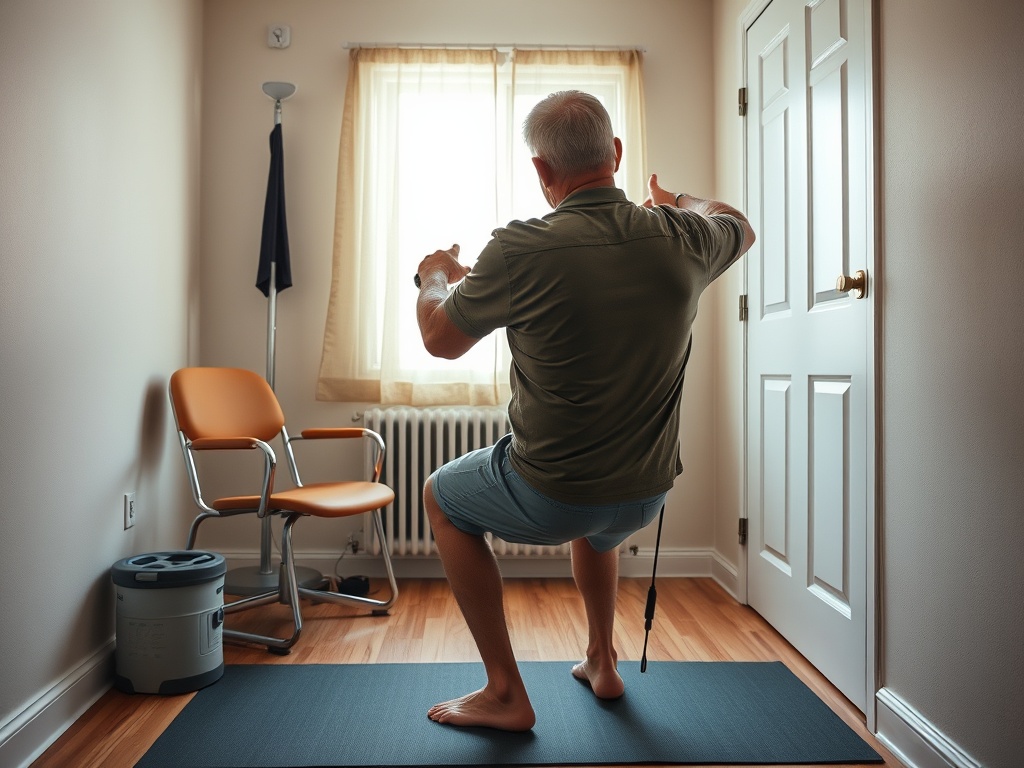
Stand behind the chair with light fingertip support, rise onto the balls of the feet, pause, and lower with control. Progress by reducing support, adding repetitions, or eventually training one side at a time if balance permits.
6. Marching or step taps
March in place or tap one foot to a low step. Keep the pace conversational at first. Add time, arm movement, or short brisk intervals as fitness improves. This supplies an aerobic element without leaving the room.
7. Supported balance practice
Near a stable support, narrow the stance, place one foot slightly ahead of the other, or briefly lift one foot. The correct level feels challenging but controlled. Do not close your eyes or use an unstable surface without appropriate supervision.
A private beginner routine
Perform the routine two days per week with at least one recovery day between sessions:
- Warm up with three to five minutes of easy marching and comfortable joint movements.
- Complete one set of five to ten sit-to-stands.
- Complete one set of wall push-ups.
- Practice five to eight supported hip hinges.
- Complete one set of band rows if the setup is secure.
- Perform calf raises and brief supported balance practice.
- Finish with several minutes of easy walking or marching.
The NHS home strength exercise guide demonstrates scalable chair and wall exercises and advises building repetitions gradually. Its examples are useful starting points, not personalized prescriptions.
Progress without buying a home gym
First add repetitions within a comfortable range. Then add a second set, a slightly harder variation, or a small amount of resistance. Change one variable at a time and keep technique stable.
Household objects can add load, but they may be awkward or difficult to grip. A backpack can shift, water containers can leak, and furniture can fail. Use purpose-built equipment when the improvised option is not secure.
Track session completion and one performance marker, such as controlled sit-to-stands or push-up angle. The article on why consistency beats intensity explains how a backup version protects the habit during busy weeks.
Add aerobic activity without leaving home
Walking indoors, marching, low-impact dance, stationary cycling, and step taps can raise heart rate. Use the talk test to judge moderate effort: breathing is faster, but speaking in sentences remains possible. Short chunks can accumulate across the week.
People with joint pain, balance limitations, or chronic conditions may need seated or supported options. Aim to be as active as abilities and conditions allow, and seek clinical guidance for safe modifications.
When a video is helpful and when it is not
Pre-recorded instruction can demonstrate rhythm and setup, but it cannot see your symptoms or confirm that a movement suits your health. Preview the session, check that alternatives are offered, and pause rather than rushing to match the instructor.
You do not have to activate a camera to exercise effectively. If an app requests video access, review what is recorded, where it is processed, how long it is stored, and how to delete it. Privacy preferences should shape tool choice.
Safety signals that require a different response
Stop exercise for chest pain, fainting, severe or unusual shortness of breath, sudden weakness, or other urgent symptoms and seek appropriate care. Sharp or worsening musculoskeletal pain, swelling, numbness, or a change in walking pattern also deserves assessment.
People recovering from surgery or injury, managing unstable health conditions, pregnant or postpartum, or at significant fall risk should obtain individualized guidance. A physiotherapist or qualified exercise professional can teach movements in a private one-to-one setting or through a secure telehealth option.
Nutrition also supports training, even for short home sessions. Use the meal-planning framework for strength and cardio when training volume grows, without assuming every brief workout needs special products.
Begin with a six-square-foot commitment
Clear a small space, choose four movements, and complete one controlled set of each twice this week. Privacy can remove a barrier, but progress still comes from a routine that is safe, appropriately challenging, and repeated.