Officiating signals help fans and players understand what was called, who is affected, and what happens next. Newcomers should learn the most common stop-play, possession, scoring, foul, and safety signals before memorizing every sport-specific variation.
Reader takeaway: Signals are a shared language. They reduce confusion when noise, distance, or emotion makes verbal explanations difficult.
Why officials use signals
Sports move faster than explanations. A whistle may stop play, but the signal tells everyone why. Officials use body language to communicate with players, coaches, scorekeepers, broadcast crews, and fans at the same time.
The National Association of Sports Officials provides education and rules resources for officials across sports, and its work shows why mechanics are part of credibility. A clear signal is not decoration. It is game administration.
Signals vary by sport, but the logic is consistent: stop action, identify the ruling, assign possession or penalty, and restart play. Learning that sequence helps beginners stay oriented even when they do not know every detail.
The signal families new fans should learn first
| Signal family | What it usually communicates | Beginner question to ask |
|---|---|---|
| Stop-play | Action is dead or paused | Why did play stop? |
| Possession or direction | Which team restarts | Where does the ball or serve go? |
| Scoring | Point, goal, try, basket, or attempt result | Did it count? |
| Foul or violation | Illegal contact or rule breach | What rule was broken? |
| Safety or misconduct | Dangerous, unsporting, or administrative issue | Is there a penalty or warning? |
Signals do not replace the rulebook
A signal tells you the decision category, not always the full reasoning. For example, a basketball official may signal a foul, but the exact judgment may involve position, contact, advantage, and timing. A soccer assistant’s flag may show offside involvement, but the referee’s decision also depends on active play.
That is why fans should avoid assuming every disagreement means confusion. Officials often signal the final ruling after processing several pieces of information. For players, the best habit is to read the signal, reset quickly, and ask respectful clarification only when the moment allows.
Clock awareness also matters. Many signals interact with time, resets, and restarts, which connects naturally to how time limits shape strategy in sports.
Common examples across sports
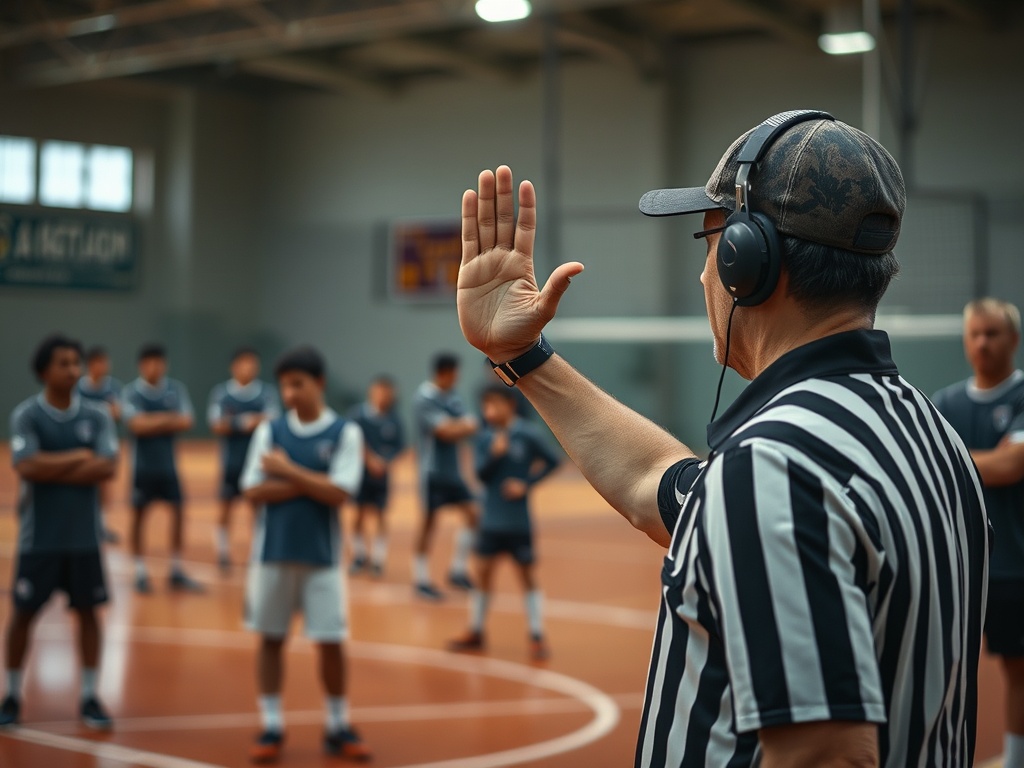
- Raised arm or whistle-stop mechanics often indicate play is dead or about to be administered.
- Pointing direction usually shows possession, serve, throw-in, or restart direction.
- Open-hand or crossed-arm signals often communicate timeout, substitution, or stoppage.
- Scoring signals confirm that points, goals, or attempts count.
- Personal-foul or misconduct signals identify illegal contact, unsporting behavior, or safety-related violations.
How players can use signals better
Players who understand signals waste less energy arguing the wrong point. If the signal shows possession, line up for the restart. If it shows a safety violation, adjust technique. If it shows a clock issue, check time and situation before reacting.
Coaches can teach signals during practice scrimmages. Instead of stopping to lecture after every call, use the official signal, ask players what happens next, and restart. This builds rules literacy without draining practice tempo.
How to watch officials without turning every call into a debate
A useful fan habit is to watch the official’s position before judging the call. Officials work angles, not television replays. A referee standing on the goal line, baseline, touchline, or behind a play may have a specific responsibility that a distant viewer does not see.
This does not mean officials are always right. It means the first question should be, “What was the official looking at?” rather than “How could anyone call that?” That mindset helps fans learn the sport instead of only reacting to frustration.
Players benefit from the same discipline. The faster they understand the signal and reset, the less likely they are to give away the next possession, point, or play through distraction.
Teaching signals to young players
Coaches can introduce signals as part of normal practice. During scrimmages, use real mechanics for out-of-bounds, fouls, substitutions, timeouts, and scoring. Ask players to explain the restart before play resumes.
This builds rules knowledge in context. It also reduces sideline confusion because athletes learn that the signal is not personal. It is a cue for what the game requires next.
What respectful disagreement looks like
Fans and players can disagree with a call without turning the moment into abuse. Respectful disagreement is brief, specific, and controlled. It asks for clarification rather than assuming dishonesty. It also ends when play must continue.
This matters because officials are part of the sporting environment. Better communication protects the game, supports new officials, and helps athletes focus on the next action instead of the last frustration.
How officials and coaches can reinforce the signal language
Officials help new participants when their signals are sharp, held long enough to be seen, and paired with calm game management. Coaches help when they teach athletes to look, listen, and restart instead of reacting emotionally to every whistle.
Leagues can support both groups by publishing signal charts, explaining rule changes before the season, and encouraging respectful questions in training settings rather than during heated game moments.
A quick viewing exercise for the next game
Pick one quarter, inning, set, or period and write down every signal you recognize. Next to each one, note the restart: possession, free attempt, serve, throw-in, replay of down, or continued play. This small exercise turns signals from isolated gestures into a working map of the game.
Read the call, then read the context
The best fans and players learn signals as context clues. They notice the whistle, the official’s mechanics, the scoreboard, the clock, and the restart. That combination turns a confusing stoppage into a readable part of the game.